
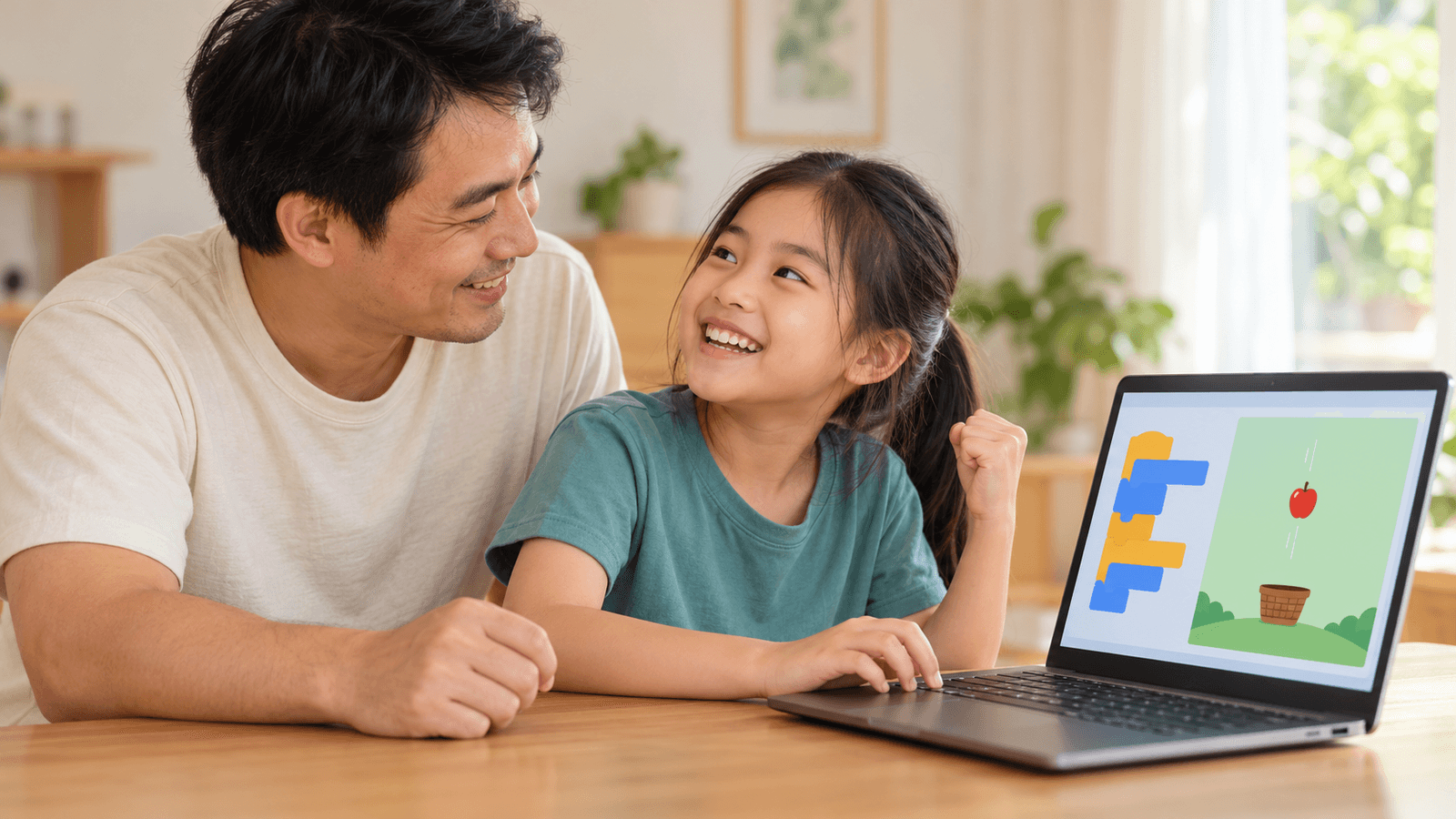
Children already know how to play a game. The interesting step is the moment they notice that someone made it, and that they could be that someone. Scratch is built for that step. Blocks instead of syntax. A sprite on a stage. A computer and a bit of curiosity.
Start with a tiny gameLink to this heading
Do not begin with a platformer that needs a week. Begin with one action. A cat moves. An apple falls. The apple lands in a basket, or it does not. The child can see the whole loop: I changed a block, the game changed. That loop is programming, even if nobody uses the word yet.
Bugs are the lessonLink to this heading
The first version will be wrong. The apple will fall forever, or the score will count twice, or the sprite will walk off the stage and never return. Those are not interruptions. They are the part where the child has to say what they thought would happen and compare it with what did. That sentence is the skill.
From player to makerLink to this heading
You do not need to turn a child into an engineer on a Saturday. You need them to feel that a game is a thing a person can change. After that, playing is never quite as passive. They start asking how it was done. Scratch is a good place for the question, because the answer is sitting on the screen in blocks they can move.